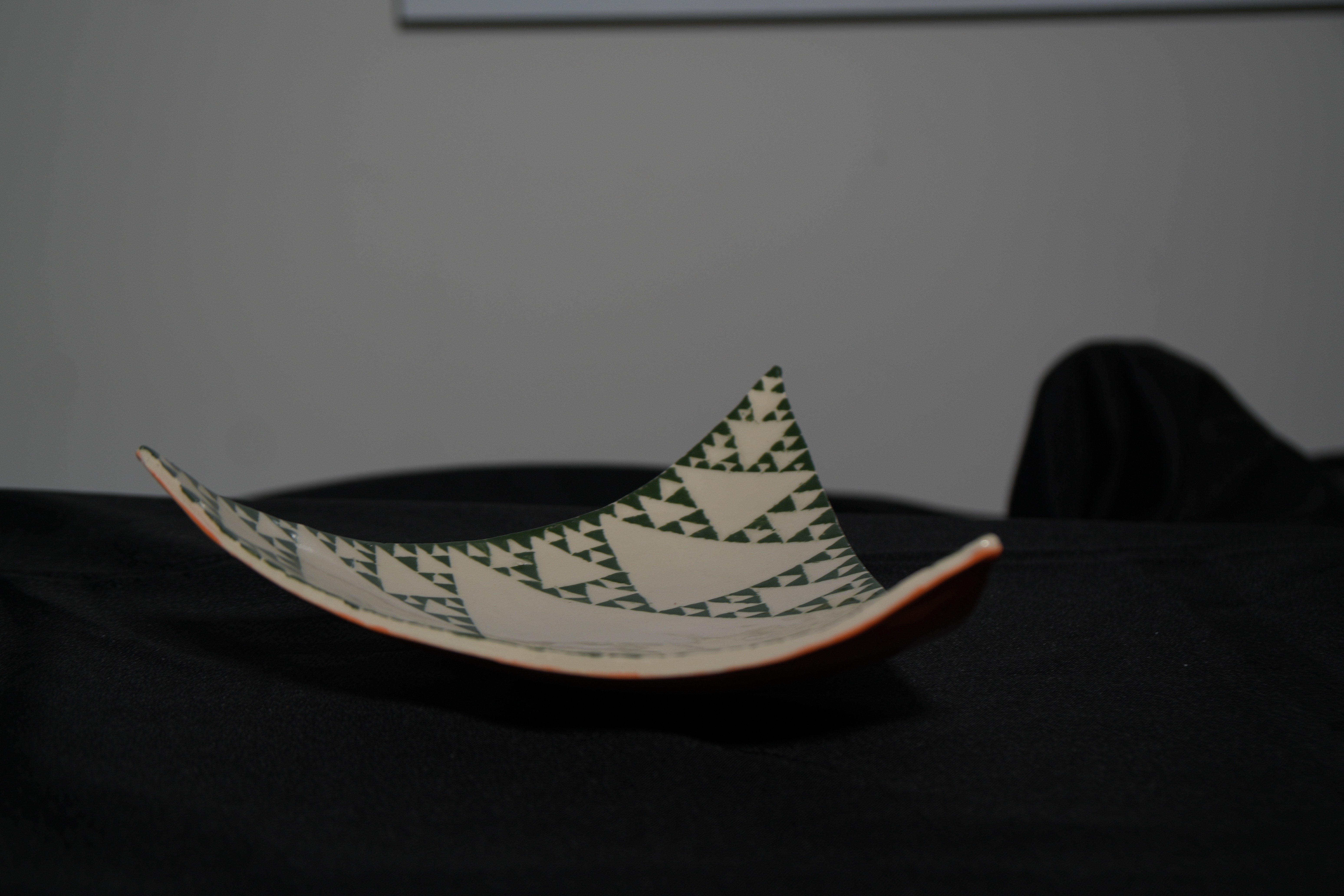

Sierpinski Ceramic Triangle
Sierpinski’ inspired triangle contemporary plate designed and made by Mandy Gordon (MSI School Manager). Hand built with stoneware clay in the shape of an equilateral triangle and delicately layered with underglazes into a fractal.

A picture of a Sierpinski triangle S, in black, is shown in Figure 1. As with objects such as line segments and circles, a mathematical Sierpinski triangle sits in the Euclidean plane. It has the following properties.
- Any two points of S are connected by an unbroken path that lies entirely in S.
- Like a straight line, S has zero area, area=0.
- S is the closure of the union of a countable set of straight line segments of infinite total length.
- There is an unbroken path in S from any point in S to any other point in S.
- S is the closure of the union of countably many triangles.
A flat version of the triangular structure on Mandyís pottery could be made like this: start from a triangular lamina and methodically remove the interiors of triangles, through Öve generations, as illustrated in Figure 2.
Now imagine repeating this step 1,000,000 times: the result (if you could really do this, which of course you cannot) would be a picture of S accurate to within 1=21,000,000
Another way to make a picture of S is via the Chaos Game algorithm, as follows. Label the vertices of a triangle O, A, and B. Also label the faces of a three-sided die O, A, and B. Then form the following sequence of points X0; X1; X2...where X0 is O and Xn+1 is the midpoint of Xn and the point corresponding to the nth roll of the die. The result of a million steps will be one million points all of which lie on the Sierpinski triangle with vertices O, A, and B.

Reference:
Waclaw Sierpinski, "Sur une courbe dont tout point est un point de ramification" Comptes Rendus de LíAcademie de Sciences, 160, 302-305 (1915).
Michael F. Barnsley, Fractals Everywhere, Dover Publications, Inc. Mineola, New York (2012)